Oat Bread: Benefits, Recipes and What Science Really Says
Oats contain 3.5 times as much fibre as wheat flour. They also contain beta-glucans, the only fibres recognised by EFSA as contributing to the maintenance of normal blood cholesterol levels. Yet many claims made about oat bread are misleading.
On TikTok, #bakedoats has 23.9 million views. Influencers talk about “gluten-free” bread, a “calorie trap”, a diet food. Scientific reality? More nuanced. And much more interesting. Quantified nutritional comparison, deconstructed myths, recipes with the right proportions: this is what the studies really say.
Oats outperform wheat flour in fiber (3.5x), magnesium (3.5x) and beta-glucans — recognized by the EFSA to contribute to the maintenance of normal cholesterol levels (3g/day). But 100% oat bread does not exist (max 25-30% substitution), oats are not gluten-free, and the satiety claim has been rejected by the EFSA. Oats are great — for the right reasons.
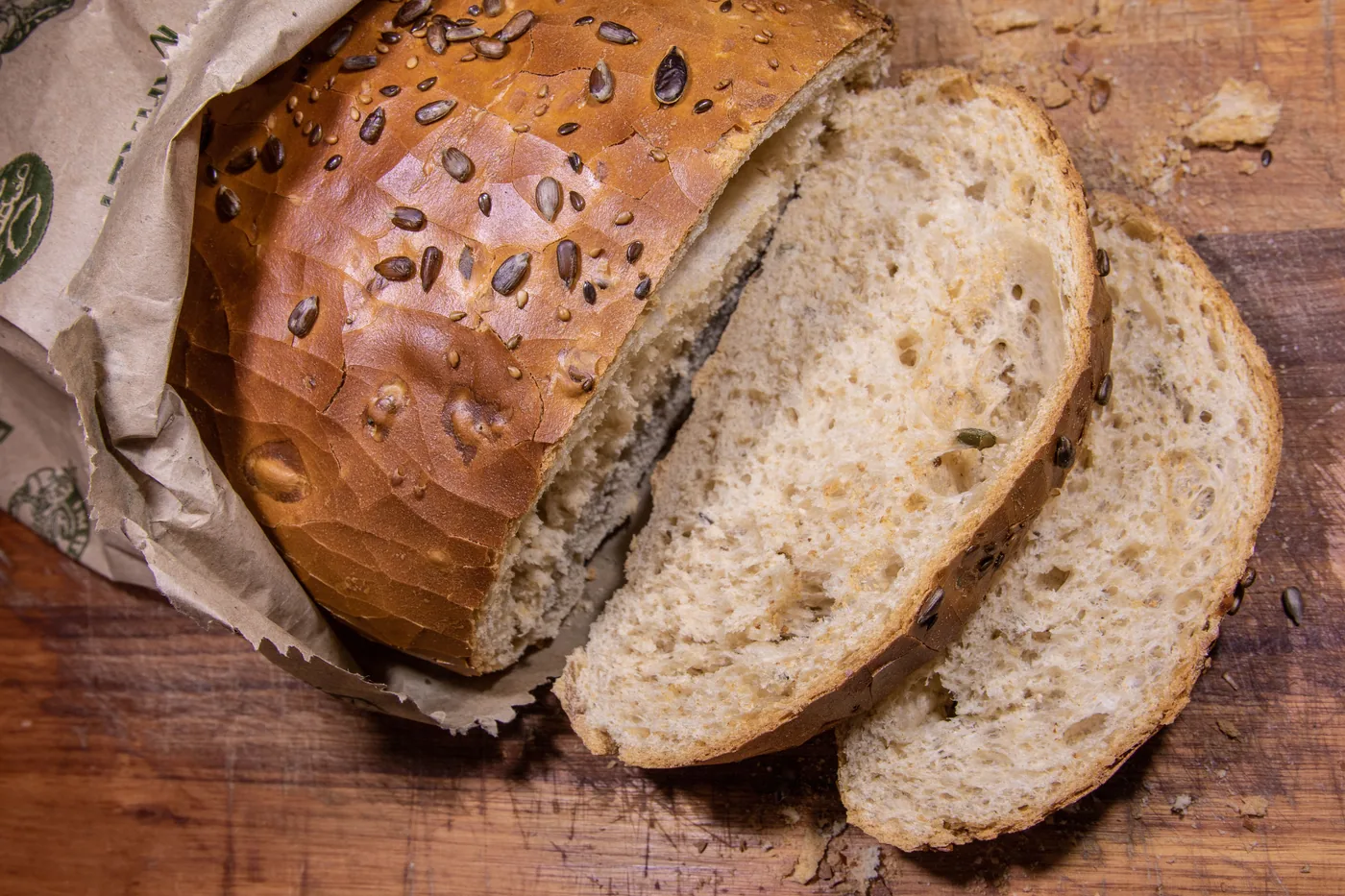
Oat flour vs wheat flour: the real nutritional comparison
The numbers speak for themselves. Here is the comparison for 100 g of flour, based on USDA data (unenriched wheat flour, equivalent of French T65):
| Nutriment | Oatmeal | Wheat flour T65 | Ratio |
|---|---|---|---|
| Proteins | 13,2 g | 12,0 g | 1,1x |
| Total fibre | 10,5 g | 3,0 g | 3,5x |
| including beta-glucans | 4-5 g | traces | >>10x |
| Magnesium | 125 mg | 36 mg | 3,5x |
| Iron | 4,0 mg | 1,18 mg | 3,4x |
| Phosphorus | 372 mg | 134 mg | 2,8x |
| Zinc | 2,75 mg | 1,15 mg | 2,4x |
| Potassium | 373 mg | 150 mg | 2,5x |
| Manganese | 3,26 mg (163 % VNR) | 0,82 mg | 4x |
| Selenium | 38,2 µg | 20,1 µg | 1,9x |
| Lipides | 6,31 g | 1,7 g | 3,7x |
Oats trump wheat on soluble fiber, magnesium, iron and zinc. But be careful: it also contains 3.7 times more lipids. Oats are therefore not “less caloric” than wheat flour – this is a common myth. Its advantage is qualitative, not caloric.
Important precision : in France, T65 wheat flour is not enriched (unlike in the United States). The comparison with unenriched flour accentuates the advantage of oats in iron (4.0 vs 1.18 mg) and folate (34.7 vs 23 µg).
Flakes, flour, bran: which form to choose?
Flakes, flour, bran: same grain, not the same results. Milling reduces the molecular weight of beta-glucans, which decreases their viscosity and action (Mäkelä et al., 2019). Concretely: whole flake porridge has a better effect on the glycemic index than bread made with fine oat flour.
What about phytic acid? Yes, oats contain it like all cereals. It reduces the absorption ofiron and zinc. But sourdough fermentation, soaking and cooking significantly reduce its content. Sourdough oatmeal is much less of a problem than a bowl of raw oatmeal.
Last nuance : most studies compare oats to refined wheat (T65). Comparisons with whole wheat (T150) are rare. Whole wheat also offers valuable fiber — but much less soluble fiber and beta-glucans than oats.
Beta-glucans: what science has proven (and what it hasn’t proven)
Oat beta-glucans are the best-studied fibers in the world. Three independent meta-analyses (28 to 58 clinical trials, up to 3,974 participants) converged on the same result (Ho et al., 2016; Whitehead et al., 2014; Yu et al., 2022).
What is proven? The impact on cholesterol.
Beta-glucans form a viscous gel in the intestine that traps bile acids. The foie must then draw on blood cholesterol (LDL-C) to synthesize new ones. Result: a reduction in LDL of 5 to 12% with 3 g of beta-glucans per day (Cicero et al., 2020 — BELT clinical trial, 83 subjects, double-blind). EFSA validated the claim: oat beta-glucans contribute to the maintenance of normal cholesterol levels (Art. 13.1).
Even stronger: the allegation Art. 14 specifies thatOat beta-glucans have been shown to reduce blood cholesterol, with high cholesterol a risk factor for the development of coronary heart disease.
Oats are also the only “fatty” grain (6.3 g of lipids/100 g, compared to 1.7 g for wheat) which reduces cholesterol. A nutritional paradox that no one mentions.
Blood sugar. Beta-glucans slow gastric emptying, which reduces the postprandial glycemic response (Wolever et al., 2020; Rieder et al., 2019). Bread containing 3.8 g of beta-glucans per serving significantly lowers the glycemic index — even when the beta-glucans are partially broken down by cooking. EFSA recognizes that the consumption of oat beta-glucans during a meal contributes to the reduction of the rise in blood sugar levels after this meal (condition: 4 g of BG for 30 g of carbohydrates).
The Hjorth et al. (2025), the first to directly compare bread enriched with oat beta-glucans to whole wheat bread over the long term, confirms the interest in glycemic control in adults at risk of type 2 diabetes.
Eating oats for breakfast even has an effect on the next meal. Researchers call this the “second meal effect”: beta-glucans digest slowly, the colon produces short-chain fatty acids, and lunch blood sugar levels drop. Two meals for the price of one.
Microbiote. Oats selectively feed good bacteria. A multicenter trial (Xu et al., 2021, 210 subjects) showed that 80 g of oats per day for 45 days increases Bifidobacteria and the production of short-chain fatty acids (propionate, butyrate).
Oats have something that wheat doesn't have: avenanthramides. Antioxidant and anti-inflammatory polyphenols, documented by Soycan et al. (2019). A 40 g serving of flakes provides 1.1 to 2 mg of avenanthramides.
What is NOT proven? Satiety and weight management.
This is the biggest myth. Wolever et al. (2020) demonstrated that beta-glucans slow gastric emptying and reduce blood sugar levels — but did not aucun effet significatif on appetite, food intake, ghrelin or PYY. EFSA rejected the satiety claim (ID 851/852). The legacy of the Dukan diet, the “calorie-trapping oat bran,” is not based on any solid evidence. The actual mechanism is the viscosity of the beta-glucans that traps bile acids, not calories.
Transparence : several key studies on beta-glucans are funded by PepsiCo/Quaker Oats or Barilla. Independent meta-analyses come to the same conclusions — but you had a right to know that.
Oats and gluten: what you really need to know
Saying that oats are gluten-free is an oversimplification at best. At worst, it's dangerous.
Oats do not contain gliadins (the wheat proteins responsible for celiac disease). It contains avenins – structurally different, as confirmed by the complete sequencing of the oat genome published in Nature (Kamal et al., 2022).
The problem ? Two levels.
First level: cross contamination. Oats are grown, transported and milled with wheat in most sectors. The result: “conventional” oats often contain traces of wheat gluten. Only certified “gluten-free” oats (< 20 ppm, EC Regulation 41/2009) guarantee the absence of contamination.
Second level: the avenins themselves. Approximately 8 to 12% of celiac patients react to pure avenins, even without contamination (Tanner et al., 2019). Immunogenicity varies depending on the oat cultivar (Huang et al., 2024). The regulations reflect this: certified pure oats are authorized in Scandinavia and the United Kingdom, but France and Italy recommend caution.
Long-term studies (5 years and more) suggest that pure oats are safe for the majority of celiac patients (Alakoski et al., 2020). But medical monitoring remains essential.
never say “gluten-free oat bread” without checking the certification. And if you are celiac, talk to your gastroenterologist before introducing oats.
Replace wheat flour with oats: the practical guide + recipes
The magic proportion: 20-30%
Oats have no functional gluten — no gliadins or glutenins, so no elastic network. Result: a 100% oat flour bread is dense, compact, and crumbles with the first knife. Commercial “oat” breads always contain 60 to 90% wheat flour.
Science provides a clear framework: up to 20-30% substitution, bread retains acceptable texture and rising properties (Krochmal-Marczak et al., 2020). Beyond 25%, the quality drops significantly (Rashed et al., 2024). Sprouted oat flour compensates a little for the problem (Cao et al., 2023), but does not change the situation.
The bakers' tip: combine oats with sourdough fermentation. Sourdough reduces the glycemic index and increases protein digestibility (Rizzello et al., 2019). A sourdough wheat-oat bread combines the beta-glucans of oats and the benefits of long fermentation.
For pancakes, pancakes and biscuits, total substitution works fine. Oats absorb more liquid — add 10-15% extra liquid to your recipes.
Sourdough wheat-oat bread
70/30
Ingredients
- 350 g of T80 wheat flour
- 150 g whole oat flour
- 350 ml of lukewarm water
- 100 g of active sourdough
- 8 g of salt
Mix the flours, add the sourdough diluted in water, then the salt. Knead for 10 minutes. Leave to rise for 4-6 hours at room temperature, shape, then bake at 240°C for 35 minutes with a bowl of water in the oven.
Why does it work? Sourdough reduces the glycemic index (Rizzello et al., 2019), and the 30% oats provide around 2 g of beta-glucans per 80 g serving.
Oat-Skyr Protein Bread
without flour, without yeast
Ingredients
- 150 g oat flakes (roughly mixed)
- 150 g of skyr or 0% white cheese
- 2 eggs
- 1 pinch of salt
- 1 tbsp. teaspoon of baking powder
Mix everything, pour into an oiled cake mold, bake for 30 minutes at 180°C.
Why does it work? This viral recipe on TikTok (#painproteine) uses no flour. Protein comes mainly from eggs and skyr (not oats alone). Honesty: it’s more of a protein pancake than a bread in the baker’s sense.
Express oat pancakes
without wheat flour
Ingredients
- 80 g of oat flakes mixed into flour
- 1 ripe banana
- 1 egg
- 100 ml of milk (or vegetable milk)
Mix the flakes, mash the banana, mix everything with the egg and milk. Cook in the pan for 2-3 minutes per side.
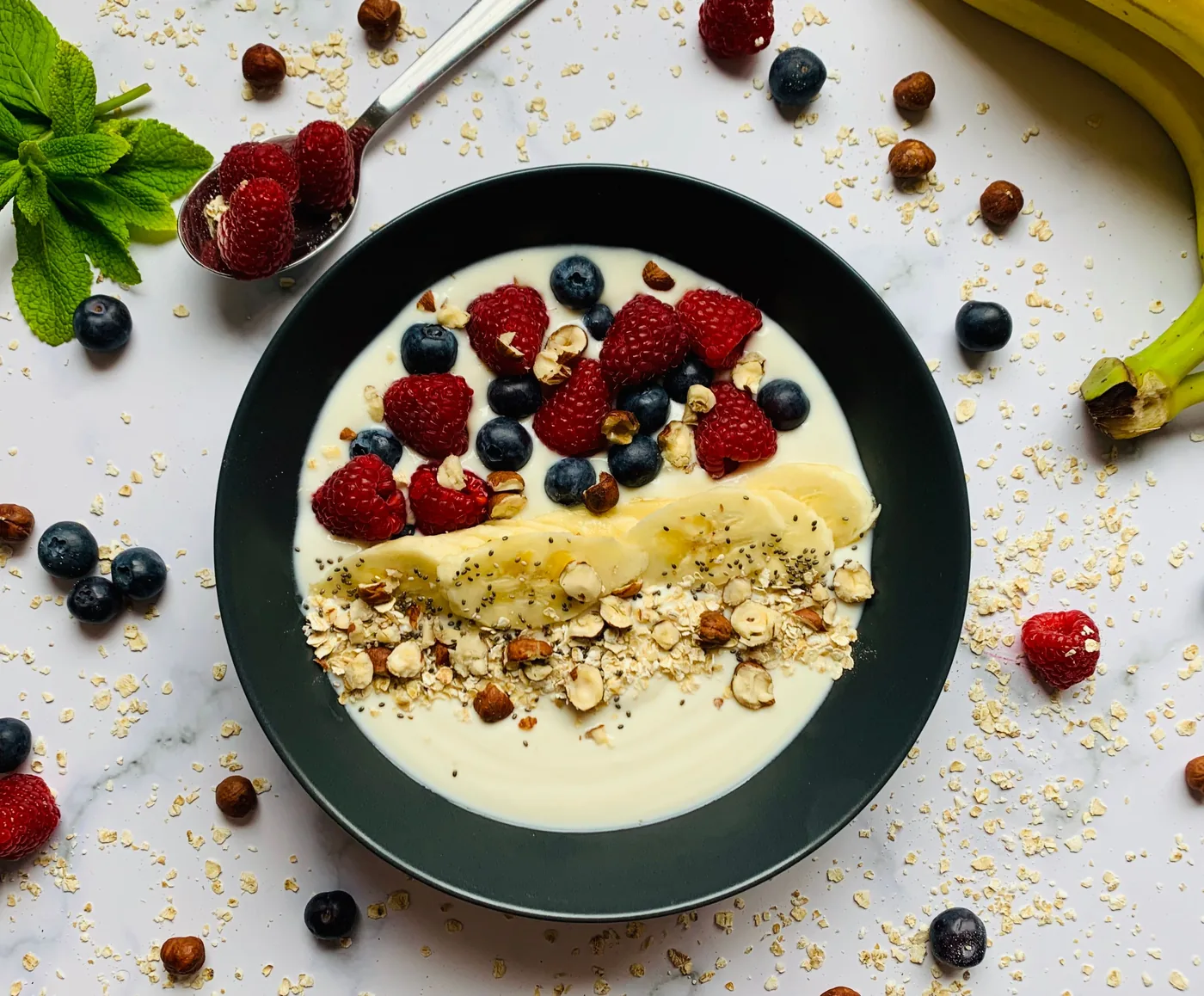
When to eat them? At breakfast, with a fresh cold-pressed juice. Whole flakes retain beta-glucans better than fine flour.

FAQ – your questions about oats and bread
Can oat flour replace wheat flour?
Yes, but partially. Oats lack functional gluten: beyond 25-30% substitution, the bread becomes dense and crumbly (Rashed et al., 2024). For pancakes and cakes, total substitution works best. Add 10-15% more liquid.
What is the glycemic index of oat bread?
The GI depends on the proportion of oats and the form used. A bread containing 3.8 g of beta-glucans per serving has a reduced GI of around 55-60, compared to 70-75 for a baguette (Rieder et al., 2019). Whole flakes work better than fine flour.
Does oat bread contain gluten?
Oats contain avenins, which are structurally different from wheat gluten. But 8-12% of celiacs react to it, and cross-contamination in the conventional sector is almost systematic (Tanner et al., 2019). Only certified oats < 20 ppm are safe, under medical supervision.
How much beta-glucan should you consume per day?
The EFSA sets the threshold at 3 g of oat beta-glucans per day to help maintain normal cholesterol levels. For the glycemic effect, you need 4 g of BG for 30 g of carbohydrates per meal. About 75g of oatmeal provides ~3g of beta-glucans.
Does oat bread make you lose weight?
EFSA rejected the satiety claim for oat beta-glucans (ID 851/852). A 2020 clinical trial shows that despite slowing gastric emptying, beta-glucans have no effect on appetite or food intake (Wolever et al., 2020). Oats are nutritionally rich, not a diet food.
What is the difference between oat flour, oat bran and flakes?
Flour is the fine ground grain — beta-glucans are partially broken down (Mäkelä et al., 2019). Flakes are the steam-flattened grain — they retain the viscosity of the beta-glucans better. The bran is the outer shell, very rich in fiber but not breadable. For the bread: flour. For the porridge: flakes.
Is oat bread good for diabetics?
Oats reduce postprandial blood sugar thanks to beta-glucans (Rieder et al., 2019). The Hjorth et al. (2025) compares bread enriched with beta-glucans to whole wheat bread in adults at risk of type 2 diabetes — the results are promising. ANSES recommends 25 to 30 g of fiber per day for adults: oats contribute significantly. Consult your doctor to adapt your diet.
Does the phytic acid in oats prevent mineral absorption?
Oats contain phytic acid, which reduces the absorption of iron and zinc. But sourdough fermentation, soaking and cooking significantly reduce its content (Rizzello et al., 2019). Sourdough oatmeal has much less phytic acid than a bowl of raw oatmeal.
Ce qu’il faut retenir
Three ideas to keep in mind:
- Oats outperform wheat flour in fiber, magnesium, iron and beta-glucans — with three EFSA validated claims on cholesterol and blood sugar.
- 100% oat bread is not realistic — but 20-30% oats in your bread, especially sourdough, transforms its nutritional value.
- Forget the myths : oats are not gluten-free, do not make you lose weight, and Dukan’s “calorie trap” has no scientific basis. The real benefits – cholesterol, blood sugar, microbiota – are already more than sufficient.
Let's be honest: our juices do not contain beta-glucans. Oats have a monopoly. But the pectin from apple, the beta-carotene from carrot, the anti-inflammatory compounds from ginger and turmeric — all of which go great with an oatmeal breakfast. The idea is not to replace, but to complement.
Accompany your homemade oat bread
Oats provide the beta-glucans, our juices provide the rest: apple pectin, ginger, fresh vitamins.
Cold pressed at Grasse. 24 hour delivery within Alpes-Maritimes (06).


Sources and references
Les informations de cet article sont fournies à titre éducatif. Elles ne remplacent pas un avis médical. Consultez un professionnel de santé pour toute question relative à votre alimentation, en particulier si vous êtes cœliaque ou diabétique.
This article respects our editorial charter and EFSA recommendations on health claims.