Every year, people in France spend millions of euros on energy drinks and commercial pre-workouts. Yet these products often contain questionable additives, too much caffeine, and sky-high prices.
What if the most effective natural pre-workout drink were already in your fridge?
In this article, discover the natural juices backed by science to boost your performance, the ideal time to drink them, and the mistakes to avoid.
Why choose a natural drink before exercise?
Store-bought pre-workouts promise the moon. But let's face the facts:
The downsides of commercial drinks:
- Too much caffeine (up to 400mg per serving, or 4 espressos)
- Additives and artificial sweeteners
- Price: 1 to 2€ per serving
- Side effects: heart palpitations, sleep problems, dependence
The benefits of natural juices:
- Zero additives: just fruits and vegetables
- Easy to digest: no bloating during exercise
- Complete nutrients: vitamins, minerals, antioxidants
- Reasonable price: especially if you press them at home or subscribe
But be careful: not all juices are created equal. Some are proven effective by science. Others are just marketing. Let's see which ones really work.
Beet juice: the science-backed star
If you only remember one natural pre-workout drink, make it this one.
Beet juice has been the subject of dozens of scientific studies. The results are clear.
How does it work?
Beets are naturally rich in nitrates. Once digested, these nitrates are converted into nitric oxide (NO), a powerful vasodilator.
In practice:
- Your blood vessels widen
- More blood reaches your muscles
- More blood = more oxygen and energy
- Your muscles tire more slowly
What the studies show
| Effect | Improvement |
|---|---|
| Time to exhaustion | +25% |
| Time over a set distance | -2% |
| Oxygen consumption | Reduced |
| Lactic acid buildup | Delayed |
A 2025 umbrella review (a meta-analysis of meta-analyses) covering 15 meta-analyses and 118 studies confirmed these results (PubMed 40573069).
The Australian Institute of Sport now officially recommends it for athletes.
Amount and timing: the protocol that works
| Parameter | Recommendation |
|---|---|
| Amount | 500ml of juice OR 2 concentrated shots (70ml) |
| Timing | 2 to 3 hours before exercise |
| Frequency | Ideally 3-7 days before a competition |
Important precautions
- Skip mouthwash before drinking: it kills the oral bacteria needed to convert nitrates
- Colored urine: this is normal, it's betanin (a red pigment)
- Possible digestive upset: try it before a competition, not on race day
4 other effective natural juices before exercise
Not a fan of beet juice? Here are natural alternatives that also work.
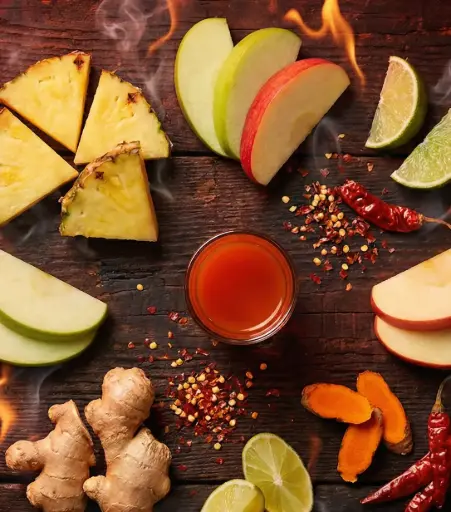
1. Apple-ginger juice: the energizing pain reliever
Ginger is one of the most studied ingredients in sports nutrition. A study published in the Journal of Pain showed that 2g of ginger per day reduced muscle pain by 23 to 25% in the 24 hours after exercise (PubMed 20418184).
Proven properties of ginger:
- Anti-inflammatoire : inhibe la production de prostaglandines
- Anti-DOMS: reduces post-workout soreness
- Digestive: helps prevent stomach trouble during exercise
Timing: 30 to 45 minutes before exercise
2. Diluted citrus juice: the vitamin C boost
Orange, lemon, grapefruit: citrus fruits are rich in vitamin C and fast-acting carbs.
The ideal formula: 1/3 citrus juice + 2/3 water
Timing: 1 hour before exercise
3. Coconut water: optimal hydration
Coconut water is a natural isotonic drink. It contains potassium, magnesium and sodium - perfect for replacing what you lose through sweat.
Timing: 30 minutes before and during exercise
4. Green juice (spinach-celery-apple): the anti-fatigue pick
Green juices are rich in iron and minerals. Perfect for long endurance efforts.
Timing: 1 to 2 hours before
When and how should you drink your juice before exercise?
| Type of juice | When to drink it | Amount |
|---|---|---|
| Beet | 2-3h before | 500ml or 2 shots |
| Apple-Ginger | 30-45 min before | 250-300ml |
| Diluted citrus | 1h before | 400-500ml |
| Coconut water | 30 min before + during | 300-500ml |
| Green juice | 1-2h before | 250-300ml |
What to avoid
- Overly sweet juices (more than 30g of sugar/L): risk of digestive issues
- Drinking on an empty stomach right before exercise: stomach discomfort
- New juices on competition day: always test them beforehand
Bonus: 3 natural juices for recovery
While pre-workout juices can support your performance, other natural juices have been studied specifically for post-exercise recovery. A 2025 scientific review analyzed all the studies on this topic (PMC12389966).
1. Tart cherry juice: the recovery favorite
Tart cherry juice (also called sour cherry) is used by professional sports teams, including the U.S. women's soccer team.
What the science says (PubMed 28696985) :
- Significantly reduces post-exercise muscle soreness
- Speeds up recovery of muscle strength
- Lowers inflammation markers (CRP, IL-6)
Protocol: 250-350ml of juice, 2x/day for 4-5 days around a competition
2. Watermelon juice: for sore muscles
Watermelon is naturally rich in L-citrulline, an amino acid that improves blood flow.
What the science says (PubMed 23862566) :
- 40% reduction in muscle soreness 24h after exercise
- Improved heart rate recovery
Timing: 500ml 1h before exercise OR after exercise
3. Pomegranate juice: the antioxidant shield
Pomegranate is one of the fruits richest in polyphenols, with higher antioxidant capacity than green tea.
What the science says (PubMed 30350760) :
- Reduces oxidative stress caused by exercise
- Improves the antioxidant response for up to 48h after exercise
Timing: 250-500ml, 1-2h before or after exercise
FAQ: your questions about natural drinks
Does beet juice have a strong taste?
Yes, the "earthy" taste of beets can be surprising. Tip: mix it with apple and a little lemon. It tastes great and you keep the benefits.
Can you mix several juices?
Absolutely. In fact, the beet-apple-lemon combination works really well: you get the nitrates from the beet, the carbs from the apple, and the vitamin C from the lemon.
Are these juices suitable for every sport?
The effects are especially noticeable for endurance sports (running, cycling, swimming) and intermittent efforts (soccer, basketball, HIIT). For pure strength training, apple-ginger juice is a better fit.
Where can you find these juices?
Cold-pressed juices retain nutrients better. You can make them at home with a slow juicer, or choose local producers who deliver fresh juice.
Want to Try It?
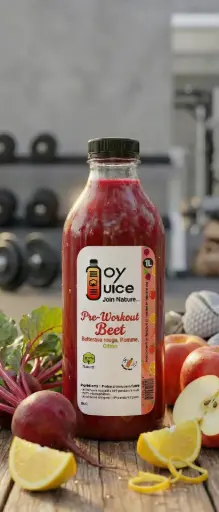
Our Pre-Workout Beet combines the 3 ingredients recommended by research:
- ✓ 55% organic beets from Villeneuve-Loubet (nitrates)
- ✓ 35% apples from Vence (natural carbs)
- ✓ 10% organic lemons from Menton (vitamin C)
100% local, 100% Alpes-Maritimes, cold-pressed in Grasse, never heated or pasteurized.
Delivery within 24 to 72 business hours in the Alpes-Maritimes
Scientific sources
PubMed studies (peer-reviewed):
- Beets: Umbrella review 2025 (15 meta-analyses) - PubMed 40573069
- Gingembre & DOMS : Black CD et al. Journal of Pain 2010 - PubMed 20418184
- Tart cherry: Vitale KC et al. Literature review 2017 - PubMed 28696985
- Watermelon & L-Citrulline: Tarazona-Díaz MP et al. 2013 - PubMed 23862566
- Pomegranate: Ammar A et al. Systematic review 2018 - PubMed 30350760
- Overall review: Juice-Based Supplementation Review 2025 - PMC12389966
Additional sources:
- Australian Institute of Sport (AIS) - Supplement Framework
- Futura-Sciences
- Vidal
This article follows our editorial guidelines and EFSA recommendations on health claims.
The information in this article is provided for educational purposes. It does not replace medical advice. Consult a healthcare professional with any questions.